


Many plants have heard of “separators” or “centrifugal separators”, but are not sure how they work or which applications they suit. This article explains in plain terms what a centrifugal separator is, how it works, the main types, and how to choose the right one for your production.
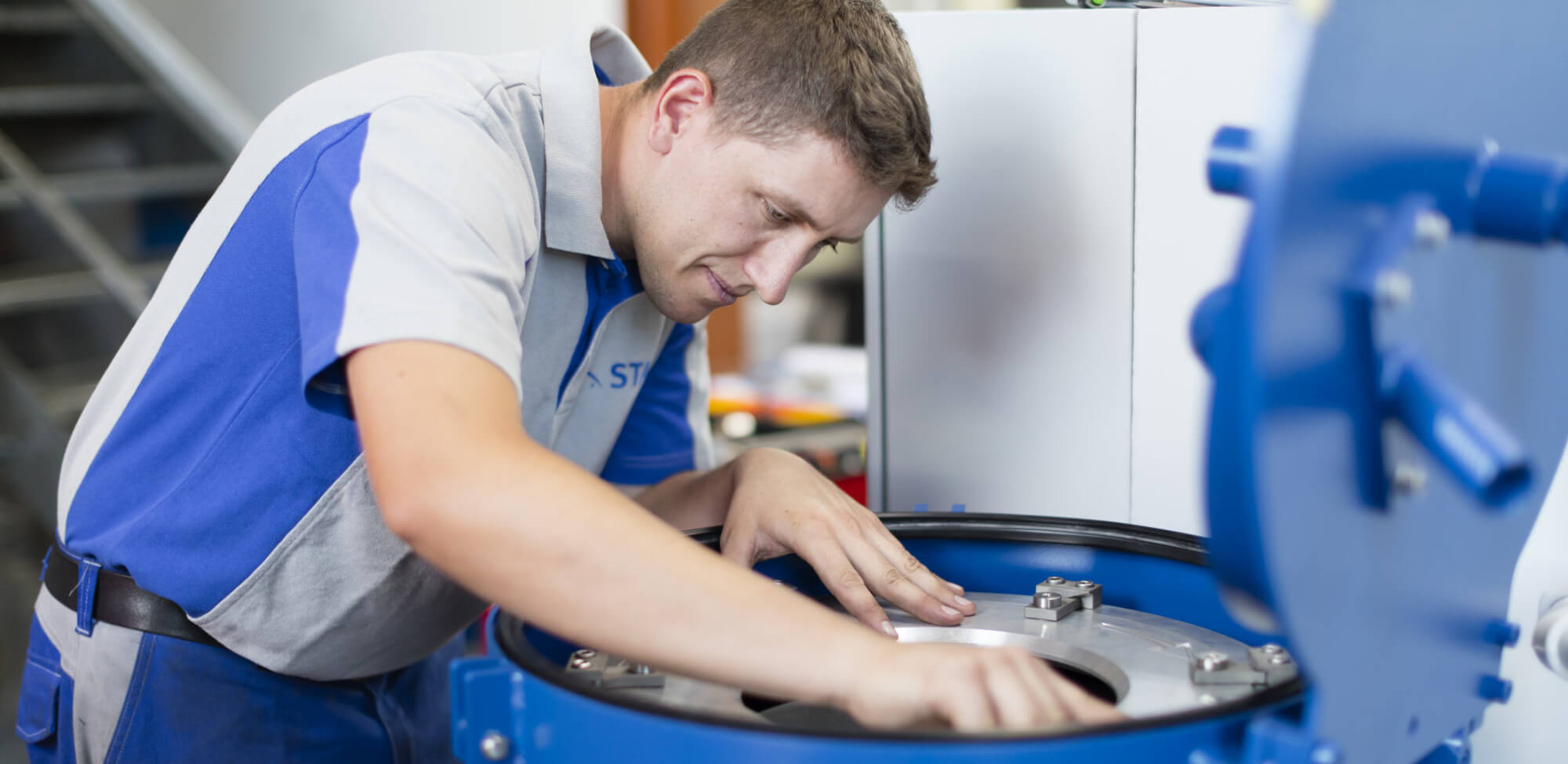
What is a centrifugal separator?
A centrifugal separator uses the centrifugal force of a fast-spinning drum to separate materials with different densities – for example solid particles from a liquid, or oil from water. In manufacturing, separators are mainly used to clean process liquids such as coolants, emulsions, cutting oils, parts-washing fluids and spray booth water.
How does a centrifugal separator work?
If you leave a dirty liquid standing in a tank, the heavier particles slowly sink to the bottom under gravity. Very fine particles can take weeks or even months to settle. A centrifugal separator uses the same principle but speeds it up enormously:
- The dirty liquid is fed into a drum that spins at high speed.
- The centrifugal force reaches around 2,000 times the force of gravity (x g), so separation happens thousands of times faster.
- Solid particles are pressed against the drum wall and form a compact, fairly dry sludge layer.
- The clean liquid flows out of the separator and back into use.
- When the drum is full, the sludge is removed by hand or automatically.
A good separator removes particles down to about 1 µm – without filter elements or any other consumables.
What types of centrifugal separators are there?
Disc stack separators
A stack of conical discs spins at very high speed. They are well suited to separating two liquids from each other or removing small amounts of solids, for example in fuel and lube oil cleaning or in the food industry.
Decanter centrifuges
A horizontal rotating bowl with a screw conveyor that discharges solids continuously. Decanters suit liquids with a high solids content, for example dewatering sludge from wastewater treatment.
Drum centrifuges
A solid-wall drum collects the sludge inside. Drum centrifuges are ideal for removing very fine particles from process liquids with a low to medium solids content – such as grinding coolant, honing oil, vibratory finishing water and parts-washing fluid. STA separators from Germany are drum centrifuges.
2-phase or 3-phase?
- 2-phase: separates solid particles from the liquid. This covers most applications.
- 3-phase: separates solids and also removes tramp oil from water-based fluids in one step – ideal for coolants and washing fluids contaminated with machine oil.
What are centrifugal separators used for?
- Coolants and emulsions from turning, grinding and cutting
- Cutting and honing oils
- Wire drawing oils and emulsions
- Parts-washing fluids and degreasing baths
- Phosphating and other pre-treatment baths
- Spray booth water (paint sludge separation)
- Vibratory finishing water
- Glass grinding and wafer dicing water
Centrifugal separator vs. filters
- No filter costs: nothing to buy and no used filters to dispose of.
- Finer separation: down to about 1 µm, even in high-viscosity liquids.
- Dry sludge: low residual moisture means less weight to dispose of.
- Longer fluid life: fewer fluid changes, lower chemical and disposal costs.
- Stable quality: consistently clean fluid means better surfaces and less tool wear.
How to choose the right centrifugal separator
- Flow rate: how much liquid needs to be cleaned per minute, and the size of your tank.
- Solids load and particle size: high sludge volumes may call for automatic sludge discharge.
- Type of liquid: viscosity, temperature and pH determine the right materials.
- Tramp oil: if oil gets into water-based fluids, consider a 3-phase separator.
- Installation: fixed installation, or a mobile unit shared between several machines.
STA offers four main models: the NZ-50 (up to 70 l/min), the U-15 (120 l/min), the S-15 (150 l/min, for harsh applications and aggressive media) and the fully automatic A-25 (250 l/min).
Expert advice in Thailand
E&W Industrial Service Asia is the STA partner in Thailand. We offer site assessments, liquid sample tests, trial and rental units, plus local installation, training and spare parts.
Contact us for advice, or see all STA centrifugal separators.
